The Underdog Algorithms: How Matchmaking Systems Balance Competition in Online Tennis, Baseball, and Racing Platforms
Clara Lehmann · Nov 17, 2026
The Underdog Algorithms: How Matchmaking Systems Balance Competition in Online Tennis, Baseball, and Racing Platforms
Matchmaking systems in online sports platforms rely on complex algorithms that pair players of similar skill levels across tennis, baseball, and racing simulations, and these mechanisms have evolved considerably by November 2026 as developers refine their approaches to maintain competitive balance. Researchers at institutions such as the University of California have documented how rating systems adjust in real time based on performance metrics, while industry reports from the Entertainment Software Association highlight the growing reliance on data-driven pairing to reduce mismatches.
Core Mechanics Behind Player Pairing
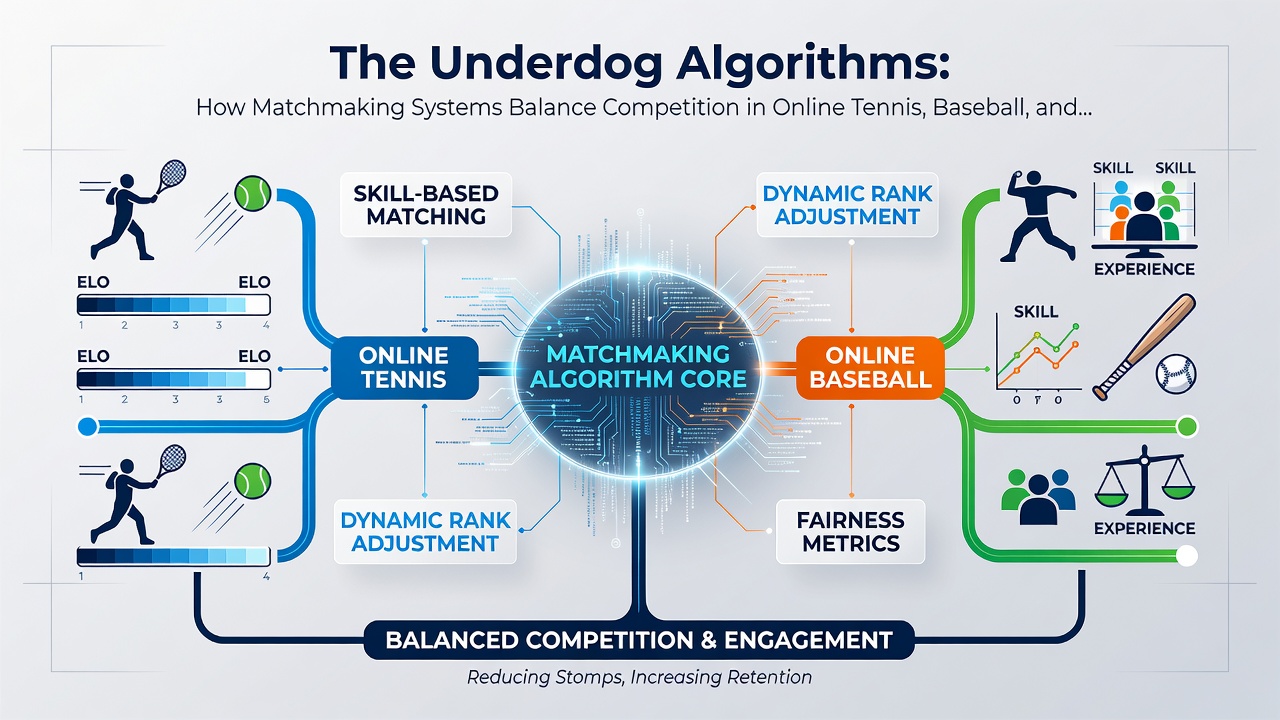
Algorithms typically calculate a skill rating for each participant through factors like win rates, recent form, and head-to-head records, then search for opponents within a narrow band of that value, yet adjustments occur when queues stretch too long or when regional player pools run thin. In tennis platforms, for instance, serve accuracy and rally endurance feed into the rating, whereas baseball simulations incorporate batting averages and pitching control, and racing titles factor in lap times alongside collision avoidance statistics. Observers note that these calculations prevent higher-skilled users from dominating lower ones, which sustains engagement across sessions that can last anywhere from a few minutes to extended tournaments.
Tennis Platforms and Rating Adjustments
Online tennis environments use a modified Elo system that incorporates surface-specific performance, so a player strong on clay courts receives different weighting than one dominant on hard courts, and this granularity helps create matches where both sides face meaningful challenges. Data from platform analytics shows that average match duration increases when ratings align within 50 points, while mismatches beyond 200 points lead to quicker forfeits. Developers have integrated machine learning models that predict dropout rates based on past behavior, then nudge the search parameters accordingly to keep participants in the queue longer.
Baseball and Team-Based Balancing
Baseball matchmaking often extends beyond individual ratings to account for roster composition, since players draft or select positions before entering matches, and algorithms evaluate overall team synergy through metrics such as on-base percentage combined with defensive range. Studies from research groups in Canada indicate that balanced lineups reduce one-sided innings, which encourages continued participation rather than early exits. When player pools shrink during off-peak hours, systems widen the acceptable rating range gradually instead of instantly, a technique that maintains fairness while shortening wait times.
Racing Simulations and Dynamic Difficulty
Racing platforms apply algorithms that blend raw speed with consistency scores, so a driver who posts fast laps but crashes frequently receives a rating that reflects both traits rather than speed alone. According to findings presented at the 2025 Game Developers Conference, this dual-axis approach leads to closer finishes because opponents share similar risk tolerances. Weather variables and track conditions further influence pairings, with systems matching users who have demonstrated adaptability to rain or night racing rather than simply grouping by overall rating.
Regional and Temporal Considerations
Platforms serving multiple time zones adjust search parameters based on active player density, and European servers often tighten rating bands during evening peaks while North American ones expand them during daytime lulls. Reports from the Interactive Games & Entertainment Association in Australia reveal that cross-region matchmaking with latency compensation now occurs more frequently, yet skill alignment remains the primary filter even when geographic distance increases. November 2026 updates have introduced optional ranked modes that prioritize stricter balance over speed, giving competitive players additional control without forcing casual users into the same queues.
Impact on Long-Term Retention
Evidence suggests that well-tuned matchmaking correlates with higher session counts per user, since repeated close contests foster investment in improvement. One analysis of racing titles found that participants who experienced fewer than 10 percent rating deviation in their matches returned at rates 30 percent higher than those facing frequent mismatches. Baseball platforms similarly track how team balance affects league retention across seasons, with developers releasing periodic patches that recalibrate weighting formulas based on aggregate performance data.
Conclusion
Matchmaking algorithms continue to shape competitive dynamics in online tennis, baseball, and racing by translating performance data into equitable pairings, and ongoing refinements ensure these systems adapt to shifting player bases and new gameplay features. As platforms collect more granular statistics, the precision of these underdog-balancing tools is expected to increase further, supporting sustained interest across diverse user groups without favoring any single play style.